mercredi 20 avril 2016

Averting one's gaze... By Thomas CASILE

"La galère" (hard times)

Les Galleries (times of plenty)

The pictures we carefully selected for this project were taken in Clermont-Ferrand’s main square. We decided to use colour photos. We took the pictures directly in front of what we were trying to capture, to get the clearest view of the scene possible.

Downtown is always noisy. Nevertheless, it doesn't always smell bad. We were took these pictures just before winter arrived, so it wasn't very cold.

The first picture depicts a homeless man sitting on the ground with his dog lying on his lap. The colours are rather sinister which corresponds to the sad scene we were witnessing. This poor man looked very depressed and tired. It was in fact an emotional moment for us because we aren't used to seeing this type of thing in our daily lives. The title we gave to this picture is: "La galère (hard times)".

The second image is of a department store in Clermont. Not an ordinary one, the fanciest one in town where only the richest people can afford to go. The building is beautiful and well kept. We were mesmerized by its beauty. The Galleries were built in 1906 by Leon and Marcel Lamaiziere. This building obviously symbolizes wealth. The title we gave to the picture is: "Les Galleries (times of plenty)".

Our goal is obviously to illustrate the contrast between wealth and poverty in our city. For that we chose pictures that symbolize poverty and wealth. In one, the poor lonely homeless man with his only friend, and in the other, the place where rich people go to spend their money. The lonely fellow is fighting the cold, his hunger and many other difficulties we don't know much about, while the rich choose to have fun and spend astronomical amounts of money on clothes, etc., instead of helping the homeless. We find this very unfair.

In 2013, in France, 454 homeless people died out in the cold. It is our duty to help people in need because we are all human and everyone has the right to live decently. Are we, as a nation, too selfish to do anything about it?

The common title we gave the pictures is: "Averting one's gaze". We chose this title because the homeless man is averting his gaze (out of shame?) and because we, the well-off, avert our gaze from the problem of homelessness. Not everyone knows about these inequalities and people try not to think about these issues. I think these contrasting pictures succeed in conveying the story. I could have chosen a picture of a rich arrogant man driving his Porsche (which I took) but this would have laboured the point… Instead, I chose the picture of the fancy shop where wealthy people go and spend their money frivolously; that way, no one in particular is aimed at and we are reminded that we are all responsible...

This city is the home of everyone who lives in it and so we should contribute to helping the ones in need who share our space. People should think twice when they come across people begging; try to put yourself in their situation and imagine how hard and tiring life must be…

Sporting the city's colours. By Maxime LANYI & Antoine JUILLARD

Goal!

Fair play

Sport is an important part of urban life, on social, cultural, economic, and even political levels. To explore this, we went to the ice rink in Clermont-Ferrand…

The first photo was taken in October 2015. It is in color, though mostly quite dark. We wanted to show the different kinds of lights, the hockey jerseys and the ads. The viewing angle is from the tribunes, not too high, not too low so as to be able to see the match and the environment too. A goal has just been scored. It shows the solidarity between the players which is really important in a team sport. The supporters are concentrated on the game. We did not use any effects to take this picture. We just pointed the camera at the game to take a picture of a match and show the atmosphere.

The second picture was taken in November 2015 from a different seat. It shows the end of the match, when the two teams are shaking hands. This is a beautiful moment because this handshake symbolizes the “fair play” that exists between two teams. All the supporters are clapping and looking cheerful. They admire the respect both teams show each other after their game. At this moment, the music is in full swing. We took the picture in panorama mode to show the width of the ice rink and to show the maximum number of supporters who are all looking in the same direction.

Both of these pictures were taken in Clermont-Ferrand on different days. The contrast is created by the two different emotions you see expressed: the rivalry and the fair play of team sports. Competition can make you want to do bad things to the opponents, like hurt them in the heat of the action, but after, at the end of the game, respect returns and the atmosphere becomes friendly. During the game, the objective is obviously victory, but, generally, at the end of the match, the tension drops.

In real life, outside the sports arena, you can express the same feelings; sometimes you do things in a confrontational way, to become “the best”. It's normal, but you have to be respectful of others nonetheless. Nowadays, however, these two ways of behaving are no longer always associated: people live their lives and don't care for others; it's “every man for himself”. This is particularly true in cities, where people live among lots of other people. It is usually different in the country, where people tend to be more attentive to their neighbors...

In a team sport, everyone cares about his teammates; if someone gets hurt, his teammates will help him. Sports teams in general are like a family.

At the ice rink, everyone meets around a wonderful match, people talk about it to their friends, and the other people go to see the matches. It is a cultural event. There is an economic aspect too because people pay, obviously.

It was freezing at the matches we attended, but the ambiance was really warm. If you are not used to watching a hockey match, the temperature can be surprising, but it's to avoid the ice melting. It was the beginning of the hockey season. The first match was against the "Français Volants" team. There was a wonderful home crowd who supported the "Sangliers Arvernes". The more the team had the hockey puck, the more the supporters screamed; it was a noisy ambiance but really cool. This sport is brutal; even the supporters sometimes scream violently at the adverse team. The supporters and their team form a real union, like a family. All the fans were concentrated on the match; all were there, together, for the same event. Each time there was a break, the music played. It reminded us of an American-style show at a basketball or football match.

On the first picture, in the foreground, there are supporters sitting on the tribunes (there is a capacity of 1,200). It was an important part of the match and that is why they are so concentrated. There are window protections in front of the first row of spectators; the puck can reach 100km/h! In the middle distance it is the match. The Auvergnats were wearing blue and orange jerseys and the Parisians black and white. On the left side, are the bars, and the pump room. We went over there during the break to drink and to warm up! In the background, you can see where the “outcasts” have to sit, just under the McDonald's panel. Exclusions are rare; there was no one there at that moment.

In the second picture, we can see many supporters in the foreground. The white of the ice rink dominates the picture; it is the central element of the photograph. The players from the two teams are shaking hands to congratulate each other on a good match.

Ice hockey became an event at the Olympic Games in 1920. But it is one of the sports which has had difficulties gaining recognition. This is because of the expensive infrastructure. The Clermont-Ferrand ice rink was created in 2005. A match is divided in three periods and opposes two teams of six players. It is impressive because you are not far from the game, you can see the players up close.

The n° 76 player of the "Sangliers Arvernes" team is Dusan Brincko. Like most of the team members, he is not from the region. Dusan comes from the Czech Republic. It is really uncommon to see foreign players in a small team like ours. Because they are professionals, they train almost every evening at the ice rink.

We interviewed Dusan. We asked him what difficulties he had had when arriving in France regarding his job, his friends, his accommodation, French culture, etc. He is the team captain; his goal is to lead his team to the "play off" and become champions, at the top of the ranking. Even if they are professional players, their wages are not sufficient to live on properly (he is currently looking for a second job). Dusan speaks good French; this helps him fit in.

A concrete maze. By Anthony PAYET & Bastien SÉRANGE

 
Where's the entrance?!


Where's the exit?!

The first photo was taken from a hill above Clermont-Ferrand, a point of view called "La Pierre Carrée". The second one was taken from a street along a military base, in front of my (Anthony's) home; it's a calm place. We chose not to use filters. The “natural” colours render best the atmosphere of the places. The first picture is a panoramic view, hence the landscape format. The second is in portrait format to emphasise the narrowness of the street.

When we took the photos, we felt good. It was fun working together. For the first one, as we were high up, we felt the cold wind. For the second, as we were inside the city, we didn't feel the wind.

In the first photo, in the foreground, there are mostly buildings. In the middle distance, just off-centre, there is the cathedral which dominates the scene and gives the photo a focus point. In the second photo, there is a long road that seems endless, framed by the wall of the military base on the left and railway tracks on the right hidden by bushes and small trees.

Photo 1 is entitled "Where’s the entrance?!" because you want to go down into the city but you don't know where the entry point is exactly. Photo 2 is entitled "Where’s the exit?!" because you are lost in the city but you do not know how to get out...

In photo 1, the main element is the cathedral. It is situated in the city centre, inside the old city. The cathedral has been on the same spot since the fifth century. The city was built around it. We see clearly on the picture that the further you go from it, the more modern are the buildings.

In photo 2, we can see a sign on the white wall: "Military property, no entry". Behind this long wall covered in barbed wire, there is a former military base. The oldest buildings date back to 1899. The railway line goes up to the former entrance to the base.

Photo 1 shows our city. We know it well. A stranger would probably see a city like any other, with ordinary buildings and nothing of particular interest apart from the black cathedral. For us, this view of Clermont-Ferrand brings back many memories. Each place is bound to events in our lives, important and insignificant ones, and we can spot particular places in relation to their personal meaning to us. Photo 2 evokes daily life, because it's the road I take every day to go to school. For us, this picture shows something that is very familiar whereas for others its significance is different: they will see an unusually empty street, lost somewhere in a place they do not know. It's a little ominous...

The common title of our photos is: "A concrete maze" because the city can be compared to a labyrinth. In photo 1, you are outside the labyrinth, dominating it. You want to enter it. In photo 2 you have been trapped in the maze and are searching for the exit! When you have lived a long time in a city, you know its maze of streets, its secret corners, its dangerous nooks and safer crannies. You do not feel lost; it is your stomping ground. If you are new to the place however, you may feel you can master it, find its “meaning”, but you often have the sensation of being lost. You may even want to leave it… Our photos tell this story.

On a more “urban geography” note, we can say that our photos illustrate the fact that cities get bigger. This is positive because they have to modernize and to attract economic activity. Photo 1 shows a small city in a rural region (cf. the background). The historic centre is surrounded by the newer quartiers. Photo 2 illustrates that it sometimes takes many years to regenerate parts of the older districts.

lundi 18 avril 2016

Back to Nature, a bit... By Lucie LÊME & Holy RALAITSIZAFY

 
Sunny weather makes people happy!

Gloomy weather makes people sad...
           
The photos were taken in the "Jardin Lecoq", the biggest botanical garden in Clermont-Ferrand. It is a place where you can relax and get away from the traffic, the noise and the pollution. The first photo was taken in September; the temperature was about 30°C! The second was taken in December during the Christmas holidays but it felt like autumn. We took these two photos because we wanted to show how seasons influence people's moods, even in the city.

In the first photo, in the background and around us, there are amazing and impressive trees and extraordinary flowers, and a duck pond with a fountain. We heard sounds which are typical in most cities when it is summer: birds singing, cars, kids playing with their parents or their friends. We could also hear the tram and the splash and hiss of the fountain.

In this photo, we were larking about because we wanted to show what people are like when it is summer. Most of the people are smiling to each other because they are happy, friendly, sociable and a little bit crazy, a bit like us! We were happy, laughed a lot and did a lot of silly faces. For once, there was no wind, no rain; it was simply a very sunny day in September. We could smell the many kinds of flowers. We almost forgot we were in the city...

In the second photo, in the background, we can see that all the trees have lost their leaves. The fountain is still working even though it is winter. Around us, some of the bushes have kept their leaves. We heard cars, the water from the fountain, but we didn't hear kids playing or laughing. We heard a baby who cried a lot. The December wind was blowing quite hard, there was also a bit of rain; the weather was gloomy. The smells were very different: we smelt the rain, the tarmac too because of the rain, and the car exhaust fumes. We were reminded that we were in a city, unlike on the day in September when we took the first photo. The flowers and trees had become insignificant. We put a black and white effect in this photo because we wanted to show the sadness of winter, and it shows the disappointment of the people. We felt happy to see each other, but we were very tired because of the weather.

Most public places in cities (shopping malls, offices, restaurants, etc.) now have temperature-controlled environments (the temperatures are always the same). They also have rather boring lighting “ambiances”. Does this influence people's emotions and behaviour, making us more calm and conformist? Our photos remind us that in a public garden at least you can “get back to Nature” a little; the seasons still exist there and they do affect our moods, good or bad.

Hello? Hello! By Laura ROMANE, Camille BERRIVIN & Mathilde MIOCHE

Hello?

Hello!

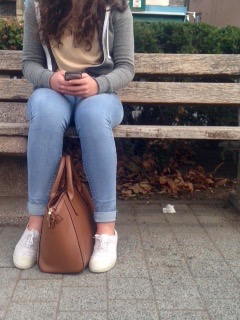
We took these pictures on Wednesday 30th of September afternoon in Place Delille near to our high school. There was a lot of noise, a little sun and the air smelt of petrol fumes. There are sometimes many people Place Delille because it is quite pleasant and there are places to sit. We come here often to hang out with each other. Most of the people sitting on the benches are usually on their cell phones.

In the first photo we took, we can see a girl sitting on a public bench. She's not paying attention to her surroundings as she is concentrating on her cell phone. In the second photo, two girls are sitting and chatting on the same bench. We cannot see their heads; this makes them anonymous. The people sitting on the bench could be you or me.

The public bench is both impersonal (it does not belong to one person in particular and it is in a public place) and personal in the sense that it is “yours” for the time you sit on it. You can do quite personal things there (put on your makeup, ‘phone, meet a friend, have a sandwich, etc.), though it is in a public place. People can sometimes have a favorite public bench and it can become a place that is part of a routine, a personal story and one’s memories. It is an apt symbol of city life, a place to be alone, or with others, among a crowd.

The city is a place where the individual can feel isolated. Does the cell phone, which has become so much more part of our lives, help us communicate better and overcome our isolation?

Communication is the subject of both pictures, but in different forms: real and virtual. Our cell phone and the social networks cut us off from the “real” world. We speak with friends, but not face to face. We hide behind our screens. Real communication is more difficult, because we can't hide our emotions; we have to be more spontaneous in front of an actual person. The negative aspect of city living is that most people spend so much time on their phones instead of enjoying their lives. Communication becomes more and more difficult because people are better at sending messages to each other rather than talking face to face.

In the countryside, people will talk to one another face-to-face more. In the city, there are a lot of people so it is should be easy to meet. You can find plenty of places where you can talk to friends and hang out with them on a nice bench!

samedi 2 avril 2016

Heaven or hell… By Rachel VAZ DE AZEVEDO

Heaven

Hell

Heaven. My first photo shows one of the symbols of a city that I’m sure you have heard about: Sydney. I visited this city for a week during my exchange visit in Australia, and it was absolutely wonderful. In this photo, I’m in front of the Opera House, and it was, as you can see, a windy but really sunny day! It was taken at the end of my trip, one week before I came back to France.

To me, that city is one of the best places to live in the world: you’ve got everything around you such as: amazing beaches, many shops, a big city centre but beautiful green spaces as well. I was full of happiness and couldn’t stop smiling even if I would have liked to have been with my family at that particular moment so that we could have discovered together what I would call my favorite place in the world. I had found my little paradise and I will do everything in my power to go back there! This photo brings back a lot of memories, and makes me sad but happy at the same time because I couldn’t have imagined an experience as wonderful as it truly was. It was the most unforgettable part of my life so far. I learnt to live with another family, discover a new country but mainly a new culture, and new people I will never forget. I think it has opened my mind. I grew more than I ever had. I’m so thankful to everyone who helped me make this trip: the tears, the laughs, the good times and less good times. But my life’s not over, I’m ready for a new chapter and I’m excited about the new opportunities and experiences I will have in my future. So, I can say that this photo represents my experience and how I felt when I did it because I look happy on it, as I was most of the time during my trip. This was particularly true in Sydney where I felt at home (I cannot explain why). I think that we maybe don’t grow up necessarily in the place we belong to… Anyway, as you can see on my face, it was truly awesome!

Hell… This photo was also taken in Sydney. It doesn’t look like it, but it actually is. It’s why I took it; it looks like it wasn’t in Sydney, not even near any city. This place is called “The Gap,” it’s an ocean cliff located towards Watson Bay, where my hotel was. But these rocks have a story. In fact, when my host family and I went to The Gap for a walk, I saw a billboard with a telephone next to it, so I asked my host family what it was and they told me something I would never have thought possible. This place is actually one of the preferred places for people to commit suicide. It has been estimated about fifty people end their lives at The Gap every year. I thought I hadn’t understood, because we were talking in English, but I actually did understand. The phone is for people who don’t feel good and need to talk. And it’s really serious! I have so many other photos I took in Sydney but I chose this one to show you because I wanted to pass on a message...

There is a terrible contrast between my two photos. I felt at home in Sydney, it was like I had found a kind of “balance” because on the one hand you’ve got the freedom of the natural spaces, and on the other hand you’ve got the city. But some people don’t feel as good as I felt, some people are, as in every country, stressed and with problems. There are sad people everywhere in the world; we don’t all have the same definition of paradise, of the dream life. This city which I call a “paradise” isn’t actually paradise for everyone…

Places need people. By Alice DE FOUCHIER & Adèle DE LAHARPE

Solitary shadows

Show of solidarity

We live in a place full of life called Clermont-Ferrand. Sometimes, though, the city is completely dead…

The first picture was taken in the Place de la Victoire. This square was built after the French Revolution. It contains a fountain at the top of which is a statue of Pope Urban II who launched the first crusade from Clermont in 1095. This statue, raised in 1895, is the work of Henri Gourgouillon. The square is surrounded by oppressive grey buildings. There are trees along the side which make you feel shut-in. We were astonished to see that there was no one in town. So we tried to make the spot look even more morose by shooting a picture with no sharp colors. We accentuated the contrast between the solitary statue and the buildings in the background. It shows the sensations we experienced while taking the photo. Indeed, we were dismayed because on this day nobody else was enjoying the urban environment in this square.

To contrast this melancholic atmosphere, we chose a second picture which represents a crowded place inspiring joy. We took this second photograph at the “Color me Rad”, in the Place de Jaude. The “Color me Rad” is an American concept which consists in running under a rain of colors. It’s a sort of race which banishes the stopwatch, originally inspired by the Holi Festival of colors in India. Since the first one in Phoenix, Arizona, in January 2012, the race has crossed the Atlantic. We chose an angle where we could see the most people because all seemed to transmit joy. We haven’t added any effects because it already portrays the emotions we felt during the race, namely enchantment and gladness. We took the picture in the middle of the race to see everybody running. Strangely, all were smiling; they seemed to be blissful together. Indeed, after the race, everybody was laughing, shouting and dancing to the music and partying together. Solidarity was emerging…

The two photos show different aspects of the city. On one is a big and empty square. We feel sadness and solitude because of the absence of life, color, or sound. The wind carries the leaves which adds to this feeling of a lifeless spot. Some days, even when the weather is good, people don’t seem to want to hang out in this square. The other picture shows a smaller place but with more people. The weather is not nice (we can see puddles), nevertheless there are a lot of people and all of them are smiling. The photo makes many feelings emerge as it is very colorful and cheerful. The atmosphere is also noisy and festive. Everybody is wearing the same tee-shirt and the same sunglasses but in different colors which encourages solidarity. It shows the “togetherness” of all these people who are wearing the same clothes but also their differences with the variety of colors. Here, we can see the need that people have to be together.

The first picture we have named Solitary shadows because of the absence of colors and also because it expresses feelings of loneliness and sadness. The light and colours and joy in the second photo inspired its title: Show of solidarity. It gives us positive feelings and a sense of belonging.

Finally, the common title is Places need people because when nobody is in town it becomes such a sad city...

Doors to the city. By Anaëlle BARNIER, Maud LAFOY & Mathilde BARDONNET

Opening to another world

The imprisoned door

We took the top picture during a walk in the narrow streets of the old Clermont-Ferrand. It was in November and, luckily, it was sunny. We were near the cathedral when we saw this wonderful huge door at the bottom of a dead end.

We took the second picture in Clermont in October during an urban orienteering race. Trying to find some beacons, we saw this austere door at a street corner. We had not seen a door like that before.

When we took the first photo, we were just having a walk without a precise aim and, with the view of this beautiful door which, moreover, was open, we had a mind to enter at once. There is a large interior courtyard and the atmosphere seemed to be quiet and restful. It was like a secret garden, hospitable and very attractive. There were lots of flower beds and clumps of shrubs. This place was silent and we were too, as if under a spell. We were in a really good mood and, being curious, we went to the open door in order to admire the wonderful garden within.

For the other picture, it was really different. We were short of breath because of the race and we had stopped running, taking our time to catch our breath and to have a closer look. The door was inaccessible because it was shut in by a metal gate. We were quite intrigued by the strange door of this gloomy house. We wondered why the people living there would shut themselves in in this way...

On the first picture, we can see an impressive wooden door which has the color of a fir tree. It is sculpted: we see a character on the arc at the top. One of the door panels is wide open and we see a large patio full of vegetation on the other side. The courtyard is paved and at the bottom we can even distinguish a table with some chairs in front of a big house.

The other picture shows a rather narrow dark green door. The door is locked tight. Indeed, the first door is locked and there is a sort of second door made up of long metallic bars. So there are two locks. Above the entrance, a canopy, also metallic and dark, complete the unwelcoming threshold. On the right of the photograph, a stone plaque is fastened over the grey and damaged wall; there is a strange Egyptian-style sculpture on it, intended perhaps to put strangers off. We have chosen to give it the title The imprisoned door because this is a door with bars and it’s like a jail door. By seeing this door, we feel as if the people inside are captives.

We have called the other photo Opening to another world because this is an open door and it seems that there is another world on the other side. If we enter, we could maybe discover new people, new cultures, because a city is a place where lots of different nationalities and various peoples live together.

Both photos were taken in the old streets around the cathedral in the old town area. The center of Clermont is concentrated around the mound where the cathedral was built. It’s the historical centre and there are lots of private properties there, including imposing mansion houses such as the one in our photo.

On the picture where there is the open door, we can see, behind the door, a garden full of plants, and we like this atmosphere, because we find that really sweet and peaceful compared to the rest of the city. Indeed, this garden makes us want to relax; the open door is like an invitation to enter, to meet the owners.

On the picture where there is the door with bars, we feel as if we are in a dangerous part of town. The door is a protection against possible attacks from outside. Furthermore, the dilapidated wall adds to the sense of insecurity, and the panel on the right looks like a mysterious warning...

We entitled our two photos Doors to the city. These doors make us imagine who the owners of the houses are; they are a clue to what the people that make up the city are like.

On the first picture, the opened door is huge and with a rounded arc. On the other, the door doesn’t have the same form: it is a rectangular door. And the atmosphere seems to be quieter on the photo with the open door than on the other picture where the railings remind us of possible dangers.

The two photos show two aspects of the city and city life. They symbolize the private part of a city because, in a city, there are all the public buildings and places but also all the private houses. In fact, people live at the same time in the private domain and in the public domain. Furthermore, people living in cities are sometimes afraid of others, they can protect themselves from the other people’s gaze by hiding themselves in their own private world, but they can also welcome somebody with open arms and help each other.

We think that our first photograph evokes this openness and friendliness, symbolized by the opening; this photo gives us a positive idea of the city because it seems to be a place full of life, joy and energy. The second photo makes us realize that in a city, things like burglaries or attacks can happen… Thus, our photos show that a city is at the same time a dangerous place but it’s also a place where you can meet people, have fun and do so many interesting things. You can feel good or be worried, it depends a lot on you…

Haunts. By Mélanie FERRON & Anne-Florence GOENVEC

 
Going downtown

On our way home

We took our black and white photos on Wednesday 23rd of September. It was cloudy, cold, wet and windy. We felt alone. Sometimes there are so few people in our streets that Clermont-Ferrand feels haunted …

The first picture shows a street leading up to the Place de Jaude. We see the new tramway. Clermont was the first French city equipped with an electric tram back in 1890; it was the pride of the citizens.

The second picture is a view down on Sidoine Apollinaire Street. Sidoine Apollinaire was a bishop, writer and poet of the 5th century. As he was Auvergnat, several streets, schools and religious buildings of the region have been named after him. In the background, we can see a part of the Chaine des Puys which is a symbol of Auvergne.

These two places are different: Jaude square is the social hub of the city (usually it is very busy). We like to go there to shop and meet our friends at a café or go to the cinema. Sidoine Apollinaire is just a thoroughfare we have to take to get to school (very busy at rush hour). However, we like both places, they are two of our many haunts (hence the common title of our photos!). The pictures reflect our mood at the time, but we love our city and, no, it is not always grey, empty and sad as people who do not know Clermont often say!

Looking up. By Elodie KANDAZOGLOU & Flora GOUTTE

Nobody notices

The future is here

We took the first photo on Thursday the 29th of October 2015 in Chamalières. We took it just before nightfall because we wanted it to show up how sad and dark the area is compared to what is shown in the second picture. The second photo is of a building in Tremonteix Street. We took it at noon because at this hour of the day the sun is brightest. It reinforced the contrast between this photo and the other photo in black and white. We were a little high up when we took the photo in order to have the surrounding panorama.
In the first photo, the weather was awful, the sky was grey and it was very cold. There was a very strange atmosphere in this place. The neighborhood was very noisy. We just wanted to run from this scary place.  While in the second photo we had the impression that we were cut off from everyday life. We enjoyed going to Trémonteix; it was after a school test, in the afternoon. It made us feel relaxed to be there and all the stress we had went away. It was so quiet. We could even hear the sounds of Nature that we usually never hear because of noise pollution.
In the first photo we can see flats. They look old and abandoned. Most of the shutters are closed. There is no vegetation. The weather was gloomy when we took the photo. We chose the title Nobody notices for this picture, because if you walk past, you won’t see these buildings.
In the foreground of the second photo we can see the vegetation and the building. In the background we can see the landscape of Clermont-Ferrand with the puy de Dôme. The building is white with nice wooden shutters. It is built using methods and materials that respect the environment. We chose the title The future is here. This picture gives us an idea of the possible architectural evolution of other parts of our city. This building is part of the Trémonteix ecovillage. Since the origins of the Trémonteix eco-neighborhood project in 2006, the City of Clermont-Ferrand and the firm Logidôme have set themselves a goal: to build exemplary affordable and sustainable housing in the Trémonteix area.

The common title is: Looking up. We wanted a positive title (as in “things are looking up”) to convey the potential of today’s housing developments and because housing is inevitably going to go vertical (because it is the only way to house a growing population and to reduce urban sprawl and transport distances). 

In the 19th and 20th centuries, building sufficient numbers of (affordable) houses for the growing population was the priority; the consequences on the environment were not always taken into consideration. Today, with the problems of pollution and destruction of nature which result in global warming, we have at last decided to protect our environment and make our towns more livable. We can see these changes through the designs of the buildings: a “closed-in” aspect for one, an “airy” aspect for the other. We decided to put a picture in black and white and the other with bright colors in order to accentuate the contrast between the old building which is not well maintained and the new building which is very clean. It creates contrasting feelings: “oppressive” versus “well-being”.

One of the main stakes today in urban design and planning is to meet the housing needs of the growing population while preserving the environment on which we depend. Judging by the Trémonteix initiative, there is hope for success.

Time's paces. By Paul BOYMOND & Pierre HOSPITAL

Plus ça change...

Tempus fugit

The first photo was taken Place de Jaude on October 4th at 18:00. The second, at the cathedral, on September 28th at 20:10. We didn't add any effects.

The first photo shows Clermont-Ferrand’s famous square. We were alone on the Place de Jaude. There is, on the left, the statue of Vercingétorix, opposite is the Rue Blatin and some of the buildings surrounding the square. In the foreground, you can see Pierre’s hand holding a tablet computer showing the square in the Fifties. You see a streetcar and a bus of that period. The interesting thing is that the buildings in the tablet and outside match. The weather was rainy that's why it isn't very colorful.  The statue in honour of the famous Gaulish warrior by Auguste Bartholdi dates from 1903. The tramway was designed by a French engineer, Jean Claret, in the late 1890s. It was the first electric tramway in France. In the 50s, the city created a bus network and the streetcars disappeared a few years later.

We took the second picture from a low angle; this makes this strange old clock on the famous cathedral of Clermont-Ferrand look quite impressive. The time is noted in Roman numerals. There wasn't any noise; we could just hear the sound of our steps on the pavement. The evening sky is dark blue. There was nobody else around at that time. It was windy and cold. We could smell the burning candles in the cathedral. We don’t know exactly when this clock was put there. It is like an eye staring at you. The cathedral Notre Dame de l’Assomption was built during the 13th century by the bishop Hugues de la Tour. The architect was Jean Deschamps. It is made of dark Volvic stone, a volcanic material used for many buildings in the region.

Plus ça change is the title of the first photo in reference to the way the town has evolved over the years but has stayed essentially the same. Tempus fugit is the second picture’s title because it is about how time flies…

Taking photos involves many emotions and memories... Our photos may not be excellent but we are quite pleased with them. Paul says: "The Place de Jaude is very familiar to me because every day I have to cross it to go to school. The clock of the cathedral is important for me because it is thanks to this clock that I learnt how to tell the time when I was five. My father and I stopped each day in front of this clock and we read the time". Pierre says: "The subject of Plus ça change is very important to me because I’m really attached to my city and I’m very interested in its history in particular its streetcars. The cathedral clock is very beautiful at night".

Time's paces is the common title of our photos. Both are about how we experience time, both as an urban community and personally. Plus ça change illustrates the slow evolution of a city. We want to make our urban environment better, but, in fact, little does change because we also want to preserve our heritage. Most of the buildings are the same, with the same functions (here, flats, offices and cafés) and the means of transport, though modernised, are basically the same (in fact, the tramline was recently brought back into service). Tempus fugit depicts the fleeting moments we each of us try to measure on our watches...

Moods. By Laetitia KOECHLIN & Nathan LIOTARD

Happy Nature

Sad city

We took these pictures at two different places but both were taken in the mountains.

The first picture was taken in the southwest of France, in the Pyrenees during the 2015 summer holidays. It was edited to show the beautiful colors of the landscape.

The other picture was taken during a class trip in October 2015 at the “Puy du Crouël” near Clermont-Ferrand. It shows the city of Clermont-Ferrand. You can see a kind of fog and that is what we wanted to highlight on this picture.

We took the first picture from inside a car. We heard the sound of wheels on the road, the sound of horns, but in contrast to these sounds, we could hear the birds in the sky. We smelt the good smells of Nature. We also remember the wind between our fingers and the hot sun on our skin because it was a sunny day.

At the moment we took the second picture, we remember that we were a little bit frozen because it was a windy day and it was raining a little. We felt the wind, the cold and the drops of rain on our skin.

In both cases, we remember the feeling of freedom. We were high up in the mountains, staring at this little world around us. We felt extremely free, obviously.

The first picture shows us a landscape. There are mountains with trees all over. The picture is colorful. We can also see three electricity pylons. This photograph is kind of joyful and I think we were both smiling, happy and into everyday life. We were simply happy when we took this picture.

The second one shows us a town. We can see trees and plants in the foreground. In the middle distance, there are a lot of buildings. There are also clouds in the sky, we can’t really see the sky because there are too many clouds and it looks like there is fog. There are not many colors. This picture is a bit sad. That is totally the opposite of our mood at the time we took this shot. We were kind of amused actually because we were with our class and with our friends.

For the first picture, we gave the title Happy Nature, because the picture is colorful, and all these colors are bright. For the second photo, we gave the title Sad city because the colors are grey, black and dark green.

The first picture was taken in the Pyrenees which is a mountain range which form the frontier (natural boundary) between France and Spain. The apex of the Pyrenees is the “Pic d’Aneto” in Spain which is 3,404 meters high.

The second picture was taken at the “Puy du Crouël” which is 15 million years old. It’s an ancient volcanic chimney. We can see some asphalt flows.

We chose Moods for the common title for our two pictures, because of the obvious contrast. The first picture shows us sun, trees, blue sky, serenity, calm; it makes us feel good. But in the second picture, we just see a polluted town; it makes us feel sad.

mercredi 30 mars 2016

Plus ça change... By Maximilien PIASTRA & Louise PALLANDRE

New art

Art nouveau

The top photo was taken in an alley off Rue des Gras in the old part of Clermont-Ferrand. We didn’t add any effects because the hues have come out just right. It was taken late in the afternoon; it was so cold that there was nobody in town. We felt alone in the middle of a deserted city. We spent a lot of time finding the right angle because the alley was so narrow. We were getting a bit fed up trying to find a good subject for our first photo so we were pleased to find this unusual spot. What we noticed first was the gloomy blank deteriorated wall and then - big contrast! - the amazing mural.

At the top of the very narrow cobble-stone alleyway is an overhanging street lamp. The wall on the left is covered in colorful street art/graffiti. The opposite wall is plain and somewhat dilapidated. The alley leads to a perpendicular street bathed in sunlight. The house at the top of the path, facing us, has an orange wall. The mural depicts a cityscape full of characters among whom a wide-eyed girl in the foreground, with flashy make up. Next to her, is the figure of a boy standing in front of a closed door and who seems scared. Further up, there’s a headless figure, then mysterious colorful drawings and signs of all sorts, mainly orange and blue. The door in the wall opposite is closed, and the windows boarded up. No one lives there anymore. The ground was wet and dirty.

We have called this picture New art because of the contrast between a contemporary artistic means of expression and the medieval architecture, and simply because the mural seems recent. We have neither the artist’s name nor a date. We like the flashy joyful colors; they lighten up this otherwise gloomy side street. The characters are dancing and playing instruments, simply having fun. The opposite wall is so sad in comparison.

The alley is in one of the oldest parts of Clermont-Ferrand near the Cathedral. Some of the original ramparts have been recently restored. Numerous buildings were knocked down to make way for the Cathedral.

Though today’s street art is not to everyone’s taste, many people approve of it because it attempts to make the walls more interesting and fun. Street art is a way for (mostly) young people to make the environment their own too and the city authorities apparently tolerate new - not always official - ways of decorating the town.

The second photo was taken at the end of a school day, Place Salford, in front of the entrance of Massillon High School, Clermont-Ferrand. We darkened the photo to give the picture a bit of drama! It was very noisy when we took this photo because many pupils were talking on the pavement. It was rainy and cloudy; we felt lost in the middle of this crowd. Though we know this area very well, it was the first time we really noticed this rather handsome old building.

In the foreground, silhouetted against a cloudy sky, is the imposing curious old building, dating from the early 20th century, with a “POSTES TELEGRAPHES TELEPHONES” sign carved in stone. There are three floors. It used to be a post-office with a  telegraph service and telephones. At the end of the 19th century, there were few telephones in homes so people used the phones in post offices, or sent telegrams abroad, or sent letters of course. Today, it is an administrative building for France Télécom.

In the background, we see the grey thundery sky and a building of the Godefroy de Bouillon High School with a much more recent architectural style.

We have called this picture Art Nouveau because the building is reminiscent of that period. This picture is a little nostalgic and a bit mysterious. It evokes the era of the industrial revolution. It has pretty flowery details on the facade and decorative balconies.

Plus ça change… would be an apt title for our two photos, taken as one work of art. Although the appearance of the urban environment may change according to the fashion of the day, the fundamental need for embellishing our city remains: Art nouveau then, new art now!

lundi 28 mars 2016

Parallel worlds. By Ombeline DESJONQUERES & Marie CANAMAS

To tramp

To rest

The black and white photo, taken Place de Jaude, shows Clermont-Ferrand as an average French city: the usual shops, obligatory tramway, busy people going about their business.

The second photo, taken in a narrow little street near Place de la Victoire, shows Clermont-Ferrand as peaceful and secret, different from other places.

We took the first photo on a really sunny and very hot Tuesday afternoon, after school. We were really exhausted and were quite in a rush to take the photo before going to our extracurricular activities. The photo we finally took corresponds very well to our states of mind at that moment. At Jaude, we heard the usual urban brouhaha: cars, buses, the tramway, busy people. We not only smelt the tarmac and filth but also the odour of make-up and perfumes from girls we bumped into.

We took the second photo on a sunny but windy Wednesday afternoon, in the historical district of Clermont-Ferrand. We were really curious and enthusiastic about discovering a whole new area of the city in which we’ve lived for years! We only heard the distant noise of the town and the wind whispering through the trees. We smelt the fragrance of leaves but a sweet odour of cinnamon pastries coming from a bakery as well…

To tramp emphasises the pedestrian aspect of Clermont-Ferrand, the fact that, in many aspects, it is like every other town. It is blurred, adding to the feeling of movement. The tramway is about to cross our field of vision. People tramp hurridly past. Behind them is the dark reflection of a sad seventies mall in the shop front of a boring new shopping mall. The only thing in focus are the sempiternal brand names; globalization strikes again! The first tramline in Clermont-Ferrand, the first to use electricity in France, was put into service on January 7 1890 by the Electric Tramway Company. For us, the tramway is a reminder of the midday rush, when we are crushed by the smelly and noisy crowd. As for the mall, it’s only a place for shopping, which may seem entertaining but actually, it’s really jam-packed and therefore, very exhausting.

To rest contrasts with the first picture, revealing the calm, intimate side of the city. We opted for an "old photo" effect to convey an "out of time" feeling. We left the door frame on the top and left as a frame for our picture, to give a "secret garden" dimension. Past the black wooden door, we catch sight of a patio, bathed in sunlight. Around a table, large dark green metal chairs and white-arabesque-shaped ones seem to be chatting, half-hidden by lush bushes. Above the arch and shadow of the Volvic stone fountain, there is a welcoming half-opened window, red geraniums overflowing from a window box.

What is surprising about Clermont-Ferrand is that there are places that are so different from each other so close by; that is why we finally gave as a common title to our two photos: Parallel worlds. 

There’s a huge contrast between those two photos. The first one represents a scene we could see anywhere in any town. This tramway, this mall, and these people we see so often we don’t even notice them anymore, these brands, they are all the same in the whole world!

But if you take time to go for a walk off the beaten track, you’ll discover charming tiny details that will bring you happiness because they’re so unexpected. The silence, the calm of these labyrinthine streets will make you feel happy and fulfilled whereas the boring town centre conveys sadness and weariness.

The first photo shows a really superficial aspect of Clermont-Ferrand. Jaude, even though it’s a pretty awesome square, is a place where the vast majority goes; therefore it has become common-place and charmless.

In contrast, the second picture presents an unknown part of the city, where very few people go though; it’s a really inspiring and relaxing place.

The first picture evokes at the same time the feeling of speed and weariness, whereas the second one shows the bohemian and quietly welcoming aspect of our city.